When to winterize your sprinkler system, by climate
Winterize your sprinkler system once a year, before the first hard freeze in the fall. Start it back up in spring, after the ground thaws and before you need to water regularly.
Colder climates need to shut down earlier in the fall and restart later in spring. In the warmest zones, where the ground doesn't freeze, a full winterization usually isn't needed, but a spring check still is. The table below gives the months for your zone, and the home maintenance calendar adds them to a full-year plan.
When to do it in your climate zone
| Climate zone | Like | Winterize the sprinkler system | Start up and check the sprinkler system |
|---|---|---|---|
| Zone 1 (very hot) | Miami, Honolulu, Key West | Not usually needed | April |
| Zone 2 (hot) | Houston, Phoenix, Orlando, Dallas | Not usually needed | March |
| Zone 3 (warm) | Atlanta, Nashville, Las Vegas, Los Angeles | October | April |
| Zone 4 (mixed) | Washington DC, New York City, St. Louis, Seattle | October | May |
| Zone 5 (cool) | Chicago, Denver, Boston, Salt Lake City | October | May |
| Zone 6 (cold) | Minneapolis, Fargo, Burlington (Vermont), Helena | September | June |
| Zone 7 (very cold) | Duluth, Caribou (Maine), Anchorage | September | June |
| Zone 8 (subarctic) | Fairbanks and interior Alaska | August | July |
Months are typical for each zone and match the free HouseByMonth calendar. Not sure of your zone? Find your climate zone. Weather varies year to year, so move a task earlier if a cold snap or heat wave arrives early.
Why winterizing matters
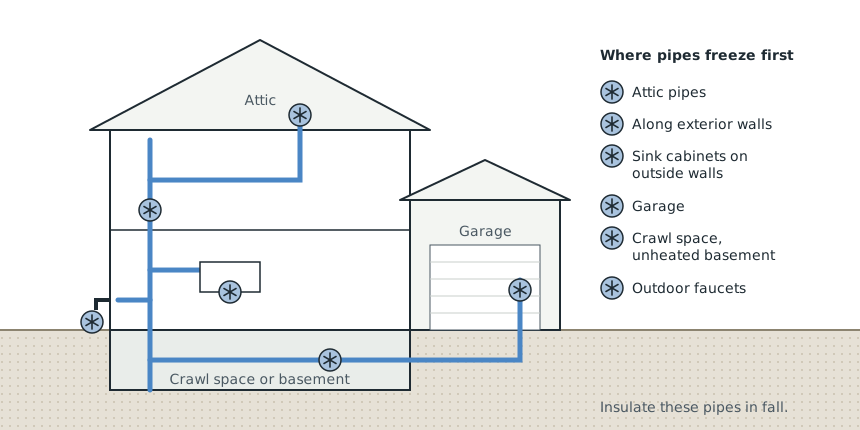
Water left in sprinkler pipes, valves and the backflow preventer can freeze and crack them. The American Red Cross lists sprinkler lines among the pipes most exposed to severe cold.
Hunter Industries, an irrigation manufacturer, says the blow-out is a yearly priority in any region where frost reaches below the depth of the buried pipes.
When to move the date up
- Your local forecast shows the first hard freeze coming earlier than usual.
- You're closing the house for the winter or leaving on a long trip.
- The system had leaks or soggy spots last season, which can hide damaged pipes.
Choosing a draining method
There are two common ways to clear the water out of the lines.
The manual drain method works only if the system was built with drain valves at the ends and low points of the lines. You shut off the irrigation water supply and open all the manual drain valves.
The blow-out method uses an air compressor to push water out of each zone. Colorado State University Extension says compressed air is the only sure way to remove enough water, and advises not to rely on manual or automatic drain valves alone.
How to winterize, step by step
- Turn off the water supply to the system, usually at a stop-and-waste valve between the water supply and the backflow device.
- Set the controller so zones don't try to run. For dial-type controllers, Hunter suggests leaving the power on with the dial set to off.
- If you're using compressed air, keep pressure in the range Colorado State recommends: 40 to 80 psi. Use no more than 80 psi for rigid PVC pipe and 50 psi for flexible black polyethylene pipe.
- Make sure the compressor is big enough. Both sources give the same rule of thumb: divide your largest zone's flow in gallons per minute by 7.5 to get the cubic feet per minute you need.
- Always keep at least one zone valve open while the compressor runs. Blow out one zone at a time until only mist comes from the heads.
- Never blow compressed air through a pressure vacuum breaker (PVB) or reduced pressure (RP) backflow device. Colorado State warns that the heat can melt their internal rubber seals.
- For a PVB, leave the ball valves and test cocks in a half-open position for the winter. RP devices have several internal parts to drain, so follow the device's manual.
- If your system has a pump, drain it and wrap it to protect it from the weather.
Compressed air safety
Compressed air in buried pipe can send debris flying. Wear ANSI-approved safety eye protection, as both Hunter and Colorado State advise.
Don't stand over sprinkler heads, valves or other parts while the system is pressurized with air. Never leave the compressor unattended.
Spring startup, step by step
- Before turning the water on, close the test cocks and ball valves on the backflow device.
- Open the main valve slowly. Colorado State notes that opening valves slowly prevents damage from water hammer.
- Run each zone and walk the yard. The EPA WaterSense program suggests looking for heads that don't pop up fully or are tilted.
- Check joints between heads and pipes for leaks. WaterSense notes that pooling water on the surface can be a sign of an underground leak.
- Turn any heads spraying onto driveways, sidewalks or walls back toward the landscape.
- Reset the controller schedule for the season.
WaterSense warns that a system with leaks and broken parts could lose up to 25,000 gallons of water over a six-month irrigation season.
Hiring an irrigation pro
Hunter recommends calling a professional for the blow-out because of the hazards involved. That is especially true if you don't own a large enough compressor or aren't sure what type of pipe you have.
Call a pro, too, for a cracked backflow preventer or a leak you can't locate.
Other freeze-prep guides
Sprinkler winterizing is part of a bigger fall checklist. See how to winterize your house for hose bibs, pipe insulation and weatherstripping.
Outdoor faucets and pipes in unheated spaces face the same freezing risk. The guide on preventing frozen pipes explains how to protect them.
Sources
- Colorado State University Extension: Preparing your sprinkler system for winter
- Hunter Industries: Winterizing your irrigation system
- EPA WaterSense: Sprinkler spruce-up
- American Red Cross: Frozen pipes
Want every task on one schedule? Build your free maintenance calendar for your ZIP code and add it to your phone.