What is my climate zone?
Every U.S. county has an official climate zone, from 1 (hottest) to 8 (coldest), usually followed by a letter: A for humid, B for dry or C for marine. Enter your ZIP code to find yours.
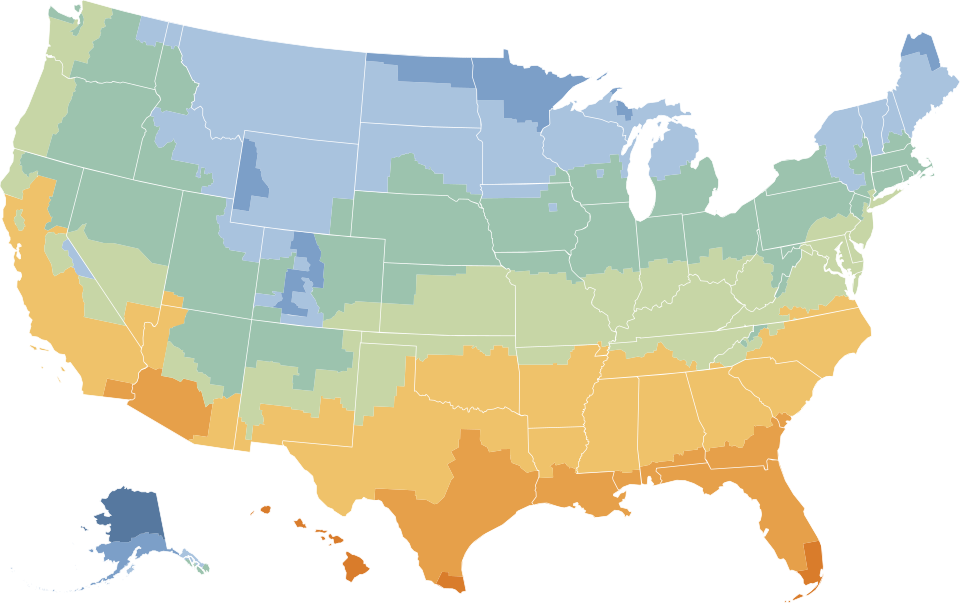
Where climate zones come from
The zones come from the International Energy Conservation Code (IECC), the model building energy code that most U.S. states adopt in some form. Builders use them to decide how much insulation and what kind of windows a new home needs. The U.S. Department of Energy's national laboratories publish the zone for every county.
The number mostly reflects how cold the climate is, measured in heating degree days: a running total of how far, and for how long, daily temperatures fall below 65°F over a year. Zone 7, for example, covers roughly 9,000 to 12,600 heating degree days, and zone 8 is anything colder. The hottest zones, 1 and 2, are set mainly by cooling degree days, the same idea measured above 65°F. Zones 1 to 3 are the hot climates, where cooling matters more than heating.
The letter describes moisture:
- A (humid): most of the eastern half of the country, with enough rain for humidity, mold and mildew to be ongoing concerns.
- B (dry): much of the West and Southwest, where rain is scarce.
- C (marine): mild coastal climates such as western Oregon, western Washington and coastal California, with cool summers, mild winters and a dry summer season.
Zones 7 and 8 don't use a letter.
The eight zones at a glance
| Zone | Climate | Typical places | Hard freezes | Cooling season starts | Heating season starts |
|---|---|---|---|---|---|
| Zone 1 | Very hot | Miami, Honolulu, Key West | No | April | Little or none |
| Zone 2 | Hot | Houston, Phoenix, Orlando, Dallas | Rare | April | December |
| Zone 3 | Warm | Atlanta, Nashville, Las Vegas, Los Angeles | Light, short | May | November |
| Zone 4 | Mixed | Washington DC, New York City, St. Louis, Seattle | Yes | May | November |
| Zone 5 | Cool | Chicago, Denver, Boston, Salt Lake City | Yes | June | October |
| Zone 6 | Cold | Minneapolis, Fargo, Burlington (Vermont), Helena | Yes | June | October |
| Zone 7 | Very cold | Duluth, Caribou (Maine), Anchorage | Yes | July | September |
| Zone 8 | Subarctic | Fairbanks and interior Alaska | Yes | Little or none | September |
The cooling and heating months are the typical starts we use in the maintenance calendar. Within a zone, elevation and distance from the coast still make a difference, so treat them as a guide.
The 2021 update
The zones were redrawn for the 2021 edition of the energy code, the first residential update to use newer climate data in many years. About 400 of the country's roughly 3,000 counties changed zone, and most of them moved to a warmer one. Older maps and websites may still show the previous zone for your county. HouseByMonth uses the 2021 zones.
How we match your ZIP code to a zone
ZIP codes don't follow county lines, so we use the Census Bureau's 2020 files that link each ZIP code area to the counties it covers. When a ZIP code spans counties in different zones, we use the county at the ZIP code's center. If your ZIP code isn't in the Census list (common for PO boxes and single large buildings), we use a nearby ZIP code with the same first three digits and tell you which one.
Why your zone matters for home maintenance
Your zone sets the rhythm of the year for your house:
- When to prepare for freezing. In zones 5 to 8, outdoor faucets, sprinklers and exposed pipes need attention in early fall. In zone 1, hard freezes are rare enough that you can skip those tasks. See how to prevent frozen pipes.
- When to book HVAC tune-ups. The cooling tune-up belongs just before your cooling season and the heating tune-up just before your heating season, which can be months apart from one zone to another. See the tune-up schedule.
- What to watch for. Humid A zones bring more mold and basement moisture; dry B zones bring dust and clogged filters; cold zones bring ice dams and frozen pipes.
The HouseByMonth calendar does this for you: it looks up your zone from your ZIP code and puts each task in the right month.
Sources
- PNNL: Guide to Determining Climate Zone by County, Building America and IECC 2021 Updates
- U.S. Department of Energy: Building America Guide to Determining Climate Regions by County
- U.S. Census Bureau: 2020 relationship files (ZIP code tabulation areas to counties)
- Green Building Advisor: Updated climate zone maps reflect warming trend
Want every task on one schedule? Build your free maintenance calendar for your ZIP code and add it to your phone.